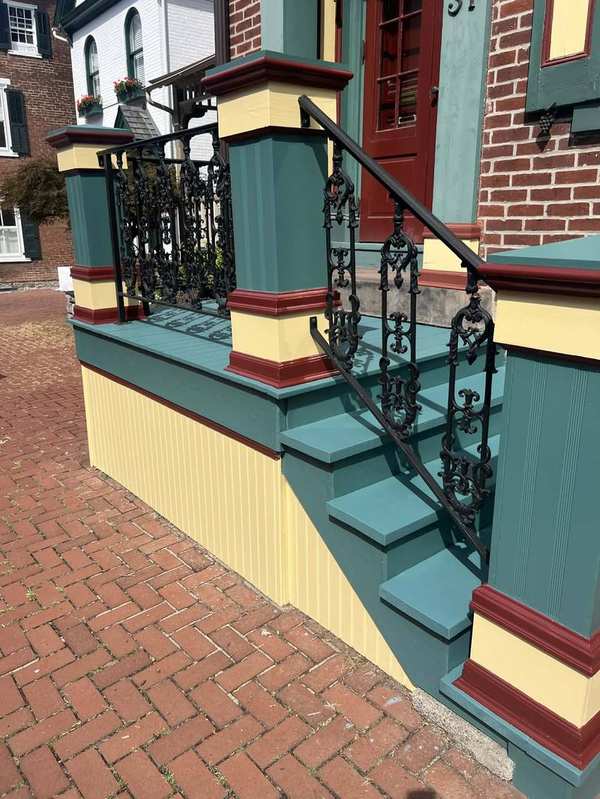
Painting a Historic Home in the Lehigh Valley - What You Need to Know
Published April 2026 - Joseph Assise III Painting & Wallpapering | (610) 252-1815 | Easton, PA
The Lehigh Valley is home to some of the most architecturally significant residential stock in Pennsylvania. Easton's College Hill, Bethlehem's South Side, Allentown's West End, and the river-facing blocks of Phillipsburg all contain homes with 100-plus years of history layered into their walls, trim, and masonry. These homes are beautiful. They are also genuinely complex painting projects that require a different approach than a standard suburban repaint.
This guide covers the main challenges of historic home painting in Pennsylvania and what homeowners should expect from any contractor they hire for the work. For exterior color guidance specific to brick and older homes, see how to choose exterior paint colors for brick homes and historic home painting in Easton, PA.
Lead Paint - The First and Most Important Conversation
Any home built before 1978 may contain lead paint. Any home built before 1940 almost certainly does - on virtually every painted surface, in multiple layers. In Pennsylvania, the Lehigh Valley has a large stock of pre-war housing, which means lead paint is a routine reality, not an edge case.
The EPA's Renovation, Repair, and Painting (RRP) rule requires contractors working on pre-1978 homes to be RRP-certified. This certification requires specific training in containment, dust minimization, and disposal procedures. It is not optional - it is federal law, and the penalties for non-compliance fall on both the contractor and, in some cases, the property owner.
What RRP certification means in practice: the contractor contains the work area with plastic sheeting, uses HEPA vacuums, does not dry-sand or dry-scrape lead paint without containment, and properly bags and disposes of all lead-containing debris. If a contractor tells you they "never had a problem" without mentioning RRP certification, that is a red flag.
Lead Paint Testing
Before major prep work begins on a pre-1978 home, testing is wise. XRF testing (X-ray fluorescence) is the most accurate method - a certified inspector holds a device against the surface and gets a reading in seconds. Swab test kits are available at hardware stores for DIY spot checks, though they are less reliable on multiple paint layers. A certified lead inspector can test an entire home and produce a written report that protects you legally and guides the contractor's prep approach.
Lead Paint Encapsulation vs. Removal
Not all lead paint needs to be removed. If the paint is in good condition - firmly adhered, not peeling or chipping - encapsulation is often the correct approach. EPA-approved encapsulants are thick, film-forming coatings that seal lead paint in place and create a durable barrier. This approach is common on intact wood siding and trim where the substrate is structurally sound. Removal is required when paint is deteriorating or when surfaces will be disturbed (sanded, scraped heavily, or replaced).
Plaster Walls - Different Rules Than Drywall
Pre-1950s homes have plaster walls, not drywall. Plaster behaves differently. It is denser in some areas, more porous in others, and prone to hairline cracks at corners, above windows, and along trim lines. Those cracks are cosmetic in most cases - but they must be addressed before painting or they will telegraph through any finish coat within one season.
The correct prep sequence for plaster interiors involves flexible crack filler or skim coat compound for hairline cracks, a high-solids bonding primer to seal uneven porosity across the surface, and full cure time before topcoat application. Old plaster absorbs moisture differently than drywall - a primer that is adequate for drywall may not seal plaster adequately, resulting in uneven sheen and poor hide.
On severely damaged plaster - wide cracks, delamination, or areas that have detached from the lath - a professional assessment is needed before painting begins. In some cases, partial or full skim coat repairs are the right call. Painting over failing plaster just delays the problem.
Original Woodwork and Millwork
Victorian and Federal-style homes in the Lehigh Valley have trim profiles, cornices, door casings, fireplace surrounds, built-in bookshelves, and decorative millwork that are irreplaceable. No modern lumber yard stocks profiles like these. Once they are damaged, reproducing them is expensive and difficult.
Painting original woodwork requires patience and discipline. Heat guns should not be used near original glass panes - the heat can crack old, often irreplaceable wavy glass. Chemical strippers work well on detailed profiles but require controlled application and full neutralization before any coating goes on. The goal is to remove failed or heavily built-up paint while preserving intact paint layers that are still adhered - not to strip every surface down to bare wood.
On intricate millwork, brush application is the only appropriate method. Spray equipment cannot navigate complex profiles without heavy overspray and runs. Rolling is for flat surfaces. If a contractor tells you they can spray your carved Victorian trim and it will look right, ask to see photos of comparable work before agreeing.
Historic District Rules in Bethlehem and Easton
If you own a home in a designated historic district in Pennsylvania, exterior changes - including paint color - may require review and approval before work begins.
Bethlehem Historic Conservation District
Bethlehem's Historic Conservation District covers large portions of the South Side and parts of the North Side, including many of the oldest and most architecturally significant homes in the region. The City's Historic and Architectural Review Board (HARB) reviews proposed exterior changes. Paint color is included in that review. Generally, the HARB favors period-appropriate palettes and discourages colors that would be anachronistic to the building's original construction period. Interior painting is not subject to HARB review.
Before choosing exterior colors on a South Side Bethlehem property, check with the City of Bethlehem's planning department to determine whether your address falls within the regulated zone.
Easton College Hill and Historic Overlay Districts
Easton's College Hill neighborhood includes a number of properties with historic overlay designations. The City of Easton's planning department can confirm whether a specific address is subject to review. The process is typically straightforward for painting projects - it is primarily about color selection, not paint brand or finish type.
Working with a contractor who has experience in historic district reviews makes this step easier. We have worked on properties subject to both Bethlehem HARB and Easton historic overlay review and can help navigate the approval process.
The Right Paint Products for Historic Homes
Paint product selection matters more on a historic home than on new construction. The wrong product can damage the substrate and fail prematurely. The right product protects and performs for 10 or more years.
Breathable Paints for Masonry
Brick and stone must breathe. These masonry materials absorb and release moisture as temperatures change, and Pennsylvania's climate - with significant humidity in summer and freeze-thaw cycles in winter - amplifies that movement. Standard film-forming latex paint applied directly to masonry creates a vapor barrier. Moisture trapped beneath the paint film causes spalling (the paint and surface layer flaking off), efflorescence (salt deposits migrating to the surface), and paint failure that often begins within two to three years.
The correct products for historic masonry are breathable mineral paints such as Keim Granital, Keim Innotop, or Romabio Classico Limewash. These products penetrate and bond with the masonry substrate rather than forming a film on top of it. They allow water vapor to pass through while protecting the surface from liquid water. They are also period-appropriate - mineral paints were used on masonry structures in Europe for centuries before latex paints existed.
On painted masonry that has already been coated with film-forming paint, the situation is more complex. Removing existing latex paint from brick is difficult and sometimes impossible without damaging the brick face. In those cases, a breathable elastomeric coating formulated for masonry may be the best available option. We assess each masonry surface individually before recommending a product.
Oil-Based Primers on Old Wood
Latex primers have largely replaced oil-based primers in modern residential work - they dry faster, clean up with water, and produce fewer VOCs. On old wood, especially bare wood on historic exteriors, oil-based primer is often the better choice. It penetrates deeper into weathered or porous wood grain, seals tannins that bleed through latex primers, and provides a more stable bond for the topcoat. The added dry time is worth the result on a surface that has been weathering for 80 or 100 years.
Paint Brands for Period Properties
For clients who want historically accurate colors, Benjamin Moore's Historical Colors collection and Sherwin-Williams' Preservation Palette are both solid starting points. Farrow and Ball's period collections are also referenced frequently, and their colors can be matched in Benjamin Moore or Sherwin-Williams base if cost is a factor. The color itself is only one part of the equation - the finish level (flat, eggshell, satin, semi-gloss) should also be period-appropriate. Flat finishes on exterior wood were standard before the 1960s; high-sheen latex on a Federal-style clapboard looks visually incorrect regardless of color.
Preserving Character While Updating
The goal on a historic home is not to make it look new - it is to make it look well-maintained. There is a difference. New construction paint jobs emphasize crisp edges, high-contrast colors, and perfect uniformity. Historic properties benefit from restraint: colors that read as natural in the context of the architecture, finishes that are appropriately muted, and attention to how colors interact with the aged patina of original materials.
One practical example: if a Victorian home has original wood shingles on the upper story and clapboard on the lower story, painting both surfaces the same color and finish often looks flat. Using a complementary body color on the clapboard and a slightly different value on the shingles - as was common in original Victorian paint schemes - restores visual depth to the facade.
We offer color consultation as part of every estimate for historic properties. This is not an upsell - it is a necessary part of the project to get the outcome right.
Hiring a Painter with Historic Home Experience
When interviewing contractors for a historic home project in the Lehigh Valley, ask these specific questions:
- Are you RRP-certified for work on pre-1978 homes?
- Have you worked on plaster walls, and how do you approach crack repair before painting?
- Do you have experience with historic district review processes in Bethlehem or Easton?
- What paint products do you recommend for masonry on older homes, and why?
- Can you share photos of work on comparable historic properties?
A contractor who cannot answer these questions specifically - not just generally - is not the right fit for an older home. The stakes are higher when the materials are irreplaceable.
Joseph Assise III Painting and Wallpapering has worked on historic properties throughout the Lehigh Valley since 2010. We are RRP-certified, experienced with plaster prep, and familiar with the historic district review processes in Bethlehem and Easton. If you have an older home and want it painted correctly, reach out for a free estimate.
Historic Home Painting Done Right in the Lehigh Valley
RRP-certified, plaster-experienced, and familiar with Bethlehem and Easton historic district requirements. Call for a free on-site estimate.
Frequently Asked Questions
Do I need a lead paint test before painting my older Pennsylvania home?
Any home built before 1978 should be tested for lead paint before any sanding, scraping, or surface prep begins. Pennsylvania contractors are required to follow EPA RRP rules on pre-1978 homes, which include certified containment, specialized removal procedures, and proper disposal. Testing is fast and inexpensive - and it protects your family.
What are the historic district painting rules in Bethlehem, PA?
Bethlehem's Historic Conservation District covers much of the South Side and parts of the North Side. The Historic and Architectural Review Board (HARB) reviews proposed exterior changes including paint color. Approved colors generally lean toward period-appropriate palettes. Interior painting is not regulated. Always check with the City of Bethlehem before choosing exterior colors on a HARB-regulated property.
Can you use regular latex paint on a historic brick or stone home?
Standard film-forming latex paint is often a poor choice for historic masonry. Brick and stone need to breathe - they absorb and release moisture as temperatures change. Film-forming paints can trap that moisture and cause spalling, efflorescence, and paint failure within a few years. Breathable mineral paints like Keim Granital or lime-based coatings are the correct choice for masonry on older homes.
How do I preserve original woodwork and trim when repainting an old home?
Original woodwork should never be stripped with heat guns near glass, and chemical strippers should be used carefully on detailed profiles. The goal is to remove failed paint while keeping intact layers that are stable. After stripping and sanding to a sound surface, a high-quality oil-based primer locks in stains and provides the best bond before a topcoat. Brush application only on intricate millwork - no spray near original woodwork detail.
What is lead paint encapsulation and when is it appropriate?
Encapsulation means sealing intact lead paint in place with a specially formulated coating rather than removing it. It is appropriate when lead paint is in good condition (not peeling or chipping) and the surface is stable. Encapsulants approved under EPA standards bond to the lead paint layer and prevent exposure. This is often the most practical approach on older wood trim and siding in good structural condition.